


esoteric connotations that go far beyond everyday language. For Christians, understanding this word helps us discern truth from hidden or secretive teachings that often conflict with the open, life-giving Word of God.
The Bible calls believers to walk in light, not darkness. 1 John 1:5 reminds us that “God is light, and in Him there is no darkness at all.” When we encounter esoteric ideas, Scripture becomes our guide and guard.
Understanding the Word “Esoteric”
Basic Definition
“Esoteric” is an adjective describing knowledge intended for a select, initiated group. It refers to teachings or information not accessible to everyone requiring special training, initiation, or insider status to understand.
From a biblical perspective, this stands in contrast to God’s nature. God does not hide salvation. Deuteronomy 29:29 says, “The secret things belong to the LORD our God, but the things revealed belong to us and to our children forever.”
Etymology and Word Origins
The word comes from the Greek esōterikos, meaning “inner” or “within.” Ancient Greek philosophers used it to separate private, advanced teachings from public ones.
Interestingly, early Christian writers were aware of this Greek tradition. The Apostle Paul himself warned against deceptive philosophies rooted in human tradition rather than Christ. Colossians 2:8 says: “See to it that no one takes you captive through hollow and deceptive philosophy.”
Modern Interpretation
Today, “esoteric” broadly means highly specialized or complex. In religious contexts, it often describes hidden spiritual teachings, secret rituals, or mystical knowledge reserved for an inner circle.
Christians must test all such teachings carefully. 1 John 4:1 instructs us: “Dear friends, do not believe every spirit, but test the spirits to see whether they are from God.”
Different Meanings and Uses
Academic and Intellectual Context
In academic settings, esoteric describes research or knowledge accessible only to specialists. Scholarly journals, doctoral theses, and technical papers often explore esoteric subjects that few outside the field can understand.
For the Christian scholar, even the deepest academic pursuit finds its foundation in God. Proverbs 2:6 tells us: “For the LORD gives wisdom; from His mouth come knowledge and understanding.”
Mystical and Spiritual Context
This is where esoteric connotations become most spiritually significant for believers. Many religious movements including Kabbalah, occultism, and certain New Age traditions claim to offer esoteric wisdom unavailable to ordinary people.
Scripture warns against these systems clearly. Isaiah 8:19 rebukes those who consult mediums and spiritists, pointing people back to God’s Word instead. True spiritual wisdom is not hidden in secret rituals it is revealed through Jesus Christ.
- Kabbalah claims hidden layers of Torah only initiates can access
- Western occultism uses esoteric rituals and secret symbolism
- Gnostic movements taught that secret knowledge, not faith, brought salvation
- All of these contradict the openness of the Gospel
John 18:20 records Jesus Himself saying: “I have spoken openly to the world… I said nothing in secret.”
Everyday Usage
In casual conversation, “esoteric” simply means something obscure or niche that most people won’t understand. A joke, hobby, or reference can be called esoteric when it appeals to very few.
Christians can use this word naturally in daily conversation without spiritual concern. The caution arises specifically when esoteric ideas claim to offer spiritual truth outside of Scripture.
Synonyms for “Esoteric”
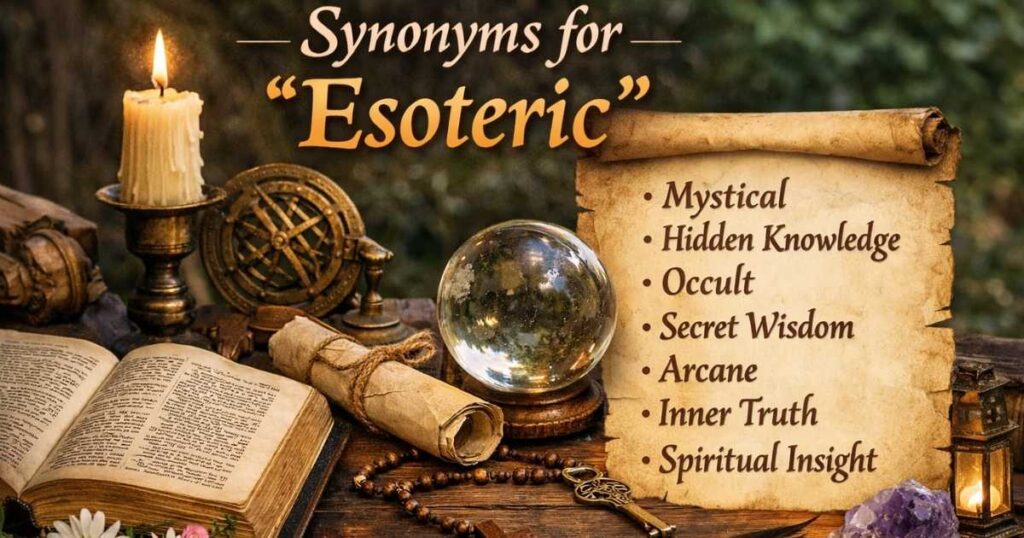
Understanding synonyms helps grasp the full range of esoteric connotations in both language and spiritual dialogue.
Obscure
“Obscure” means not well-known or difficult to find. Something obscure may be simple but rare. An obscure biblical manuscript, for example, is obscure because few people have read it not because it requires initiation.
Arcane
“Arcane” suggests mysterious, ancient, or secret knowledge. In spiritual discussions, arcane often carries occult overtones. Christians should be especially alert when teachers claim arcane spiritual knowledge unavailable in the Bible.
Recondite
“Recondite” is a formal, scholarly word meaning deeply hidden or abstruse. It emphasizes how buried certain knowledge is from general understanding. In biblical scholarship, some theological concepts may seem recondite but God’s plan of salvation never is.
Abstruse
“Abstruse” focuses on intellectual difficulty. It means hard to comprehend mentally. Paul’s letters contain passages that are abstruse, as even Peter acknowledged. 2 Peter 3:16 notes that Paul’s letters contain “some things that are hard to understand.”
Cryptic
“Cryptic” implies deliberately concealed meaning like codes or puzzles. Prophecy in Scripture can seem cryptic before fulfillment, but God’s purpose is always ultimately revealed. Amos 3:7 says: “Surely the Sovereign LORD does nothing without revealing His plan to His servants the prophets.”
Specialized and Technical
These are the mildest synonyms neutral and professional. Theology itself uses specialized and technical language: justification, sanctification, propitiation. These are not esoteric in a harmful sense they are precise tools for understanding God’s Word more deeply.
Examples of “Esoteric” in Context
Learn more:100 Amazing Bible Verse Tattoos for Men
Academic Examples
- “The professor’s research focused on esoteric medieval manuscripts rarely studied in modern seminaries.”
- “Her dissertation explored esoteric theories in early Christian Gnosticism.” (Galatians 1:6–7 warns against distorted gospels.)
- “Only a few scholars understand these esoteric philosophical concepts rooted in ancient Neoplatonism.”
- “The journal publishes esoteric articles on biblical linguistic theory.”
Spiritual and Mystical Examples
- “He studied esoteric Buddhism before encountering the truth of the Gospel.”
- “The book revealed esoteric practices of ancient alchemy practices the Bible firmly rejects.” (Deuteronomy 18:10–12)
- “Esoteric symbolism appears throughout certain secret societies’ rituals.”
- “She teaches esoteric meditation techniques borrowed from Eastern mysticism, not Scripture.”
Casual Conversation Examples
- “That sermon illustration was too esoteric for our new believers’ class.”
- “His theological humor is esoteric only seminary graduates will catch it.”
- “Her interest in ancient Christian apocryphal texts is quite esoteric compared to most churchgoers.”
- “Stop making esoteric references that newer members of the congregation won’t understand.”
Professional Context Examples
- “The commentary contains esoteric textual analysis few pastors have time to study.”
- “Legal and theological documents often use esoteric language that alienates everyday readers.”
- “The software used by biblical archaeologists has esoteric features most researchers never use.”
- “His expertise in this esoteric field of Dead Sea Scroll translation is unmatched.”
Esoteric vs. Exoteric
Definition of Exoteric
“Exoteric” is the direct opposite of esoteric. It means knowledge that is open, public, and accessible to all. The Gospel of Jesus Christ is, by nature, exoteric freely offered to every human being on earth.
Romans 10:13 declares: “Everyone who calls on the name of the Lord will be saved.” There is no secret password, no initiation rite, no hidden knowledge required.
Historical Context
Ancient Greek schools and mystery religions divided their teachings into two levels. Exoteric teachings were shared publicly. Esoteric teachings were reserved for the initiated inner circle.
Early church fathers encountered groups like the Gnostics who applied this same structure to Christianity. They claimed Jesus gave secret esoteric teachings to a special few. The church rightly rejected this. The Gospel was for everyone. Mark 16:15 commands: “Go into all the world and preach the gospel to all creation.”
Modern Application
Today this distinction is still important. Popular Christian books and sermons represent exoteric, accessible truth. Deep theological commentaries represent more esoteric though not hidden scholarly work.
The key difference from unbiblical esoteric movements is this: Christian scholarship is not secret. It is published, tested, and open to scrutiny. Acts 17:11 praises the Bereans for examining the Scriptures daily to verify what they were taught.
How to Use “Esoteric” Correctly
Choose Appropriate Contexts
Use “esoteric” when describing genuinely specialized knowledge. In Bible-related writing, it fits well when discussing complex theology, ancient manuscripts, or mystical religious movements that need to be evaluated carefully.
Do not call a topic esoteric simply because it is unfamiliar to you personally. That would misuse the word and potentially mislead your readers.
Consider Your Audience
In a devotional article for new believers, opt for simpler synonyms like “specialized” or “hidden.” In theological writing or apologetics, “esoteric” works precisely and professionally.
1 Corinthians 14:9 reminds us of the importance of clear communication: “Unless you speak intelligible words with your tongue, how will anyone know what you are saying?”
Pair with Appropriate Nouns
These combinations work naturally in Christian writing:
- Esoteric knowledge
- Esoteric teachings
- Esoteric practices
- Esoteric symbolism
- Esoteric traditions
- Esoteric connotations
Avoid Overuse
Use “esoteric” intentionally once or twice in an article is sufficient. Overuse weakens the word’s impact and can make writing feel academic rather than warm and pastoral.
Vary your vocabulary with synonyms like “arcane,” “obscure,” or “specialized” to demonstrate range and keep readers engaged.
Be Precise in Meaning
Always clarify whether you mean intellectually complex or spiritually hidden. In biblical writing, this distinction matters greatly. A complex theology is not the same as a dangerous secret teaching.
Precision in language reflects precision in faith. 2 Timothy 2:15 urges us to “correctly handle the word of truth.”
Common Phrases and Collocations
These phrases appear frequently in both academic and Christian writing:
- Esoteric knowledge Specialized or hidden spiritual information
- Esoteric teachings Secret or advanced doctrines (often unbiblical when claimed)
- Esoteric practices Mystical or ritualistic techniques
- Esoteric connotations The deeper, often hidden layers of meaning a word or idea carries
- Esoteric symbolism Hidden meanings embedded in symbols or imagery
- Esoteric traditions Religious systems built around secret, initiatory knowledge
- Too esoteric Overly obscure for a general audience
- Highly esoteric Extremely specialized or restricted in access
Esoteric in Different Fields
In Philosophy
Philosophy frequently wrestles with esoteric texts. Plato’s dialogues contain layers of meaning surface readings and deeper philosophical truths. Aristotle himself distinguished exoteric writings from his more esoteric school lectures.
For the Christian philosopher, Colossians 2:3 provides the ultimate anchor: all the treasures of wisdom and knowledge are hidden in Christ not in secret philosophical systems.
In Religion and Spirituality
This is where esoteric connotations carry the greatest weight for Christians. Virtually every world religion has an esoteric branch:
- Christianity has produced mystical traditions (some edifying, some dangerous)
- Islam has Sufi esoteric practices
- Judaism has Kabbalistic esoteric teachings
- Hinduism and Buddhism have tantric esoteric schools
Christians must measure all spiritual claims against Scripture. Isaiah 8:20 is clear: “To the law and to the testimony! If they do not speak according to this word, they have no light in them.”
In Science and Technology
Scientific fields develop esoteric knowledge naturally quantum mechanics, advanced mathematics, complex coding languages. There is nothing spiritually threatening about technical specialization.
Christians can excel in these fields to the glory of God. Daniel 1:17 tells us that “God gave knowledge and understanding of all kinds of literature and learning” to Daniel and his companions.
In Arts and Literature
Literary criticism, deconstructionist theory, and advanced music theory all carry esoteric elements. Some art is deliberately esoteric challenging audiences to search for hidden meaning.
Christians have a rich artistic heritage. From the Psalms to cathedral architecture, sacred art has always contained layers of meaning not hidden to exclude, but layered to reward the attentive heart.
Comparison Table: Esoteric and Related Terms
| Word | Primary Meaning | Biblical Relevance | Connotation |
| Esoteric | Hidden/specialized knowledge | Warns against secret teachings | Neutral to mysterious |
| Obscure | Not well-known | Rarely-studied Scripture passages | Neutral |
| Arcane | Ancient, secret, mysterious | Often linked to occult practices | Mysterious |
| Recondite | Deeply hidden knowledge | Deep theological study | Formal/academic |
| Abstruse | Hard to comprehend | Complex Pauline theology | Neutral to challenging |
| Exoteric | Open, public knowledge | The freely-offered Gospel | Positive |
| Cryptic | Deliberately concealed | Prophecy before fulfillment | Mysterious |
Tips for English Learners

Pronunciation Guide
“Esoteric” is pronounced: es-oh-TER-ik. Stress falls on the third syllable. Practice breaking it down: es – o – ter – ic, then blend it smoothly together.
Memory Techniques
Connect “eso-” to “inner” it means knowledge kept within a small group. A helpful memory hook for Christians: esoteric = kept inside, away from all; the Gospel = open and free for all. The contrast makes both words memorable.
Reading Before Speaking
Read “esoteric” in biblical commentaries, apologetics books, and theological articles. Notice how Christian writers use it when discussing Gnosticism, mysticism, or secret religious societies. Context builds confidence.
Start with Writing
Before using “esoteric” in conversation or sermons, practice writing it first. Write a sentence about a spiritual topic where the word fits naturally. Then revise and refine until the usage feels comfortable and accurate.
Practice Sentences
Here are practice sentences in a biblical context:
- “Gnostic movements promoted esoteric teachings that contradicted the open Gospel.”
- “The Dead Sea Scrolls contain esoteric texts once hidden from the general public.”
- “Paul warned against the esoteric connotations embedded in false philosophy.” (Colossians 2:8)
When Not to Use “Esoteric”
For Simply Unfamiliar Topics
If a Bible passage is simply new to you, don’t call it esoteric. Scripture is not esoteric it is fully available, fully inspired, and fully sufficient. 2 Timothy 3:16–17 affirms that “all Scripture is God-breathed and is useful for teaching, rebuking, correcting and training in righteousness.”
For Popular Culture
A trending worship song, a well-known preacher, or a widely-read devotional is not esoteric even if you personally haven’t encountered it. Reserve the word for genuinely obscure or specialized subjects.
In Very Casual Settings
In everyday conversation with fellow believers, simpler words serve better. “Unusual,” “specialized,” or “hard to understand” communicate clearly without sounding academic or detached.
When Clarity Requires Simplicity
When writing for new believers, children, or general congregations, clarity always comes first. Proverbs 8:9 reminds us that wisdom’s words are “plain to him who understands.” Choose plain language over impressive vocabulary whenever your audience needs it.
Real-World Applications
In Education
Christian educators encounter esoteric material regularly advanced hermeneutics, ancient biblical languages, patristic theology. These subjects require prerequisites and specialized training.
The goal, however, is always to bring knowledge back to accessible truth. Deep study should ultimately serve the congregation, not create an elite spiritual class. Nehemiah 8:8 describes Ezra reading Scripture and “making it clear and giving the meaning, so that the people could understand what was being read.”
In Professional Fields
Every Christian profession has esoteric dimensions. Theologians understand doctrinal esoterica. Biblical archaeologists master technical esoterica. Christian lawyers navigate legal esoterica.
This specialization is a gift, not a barrier. Experts use their knowledge to serve others, reflecting Romans 12:6–7: “We have different gifts… If it is serving, then serve; if it is teaching, then teach.”
In Hobbies and Interests
Some Christian hobbyists dive deep into esoteric interests collecting ancient coins mentioned in the Bible, studying rare illuminated manuscripts, researching early church history. These niche passions build the Body of Christ in unique ways.
Colossians 3:23 applies here too: “Whatever you do, work at it with all your heart, as working for the Lord.” Even esoteric hobbies can glorify God when pursued with purpose.
In Online Communities
Christian online communities often develop their own esoteric vocabulary theological shorthand, denominational terms, and insider references that newcomers may find confusing. This is natural but worth monitoring.
Church leaders and online ministers should regularly revisit their language. The goal is always to welcome the seeker, not impress the insider. 1 Corinthians 9:22 captures this heart: “I have become all things to all people so that by all possible means I might save some.”
FAQ’S
What does “esoteric” mean in a biblical context?
In biblical context, “esoteric” refers to hidden or secretive teachings. Unlike the open Gospel, esoteric knowledge claims exclusivity, which Scripture consistently warns believers to carefully avoid.
Are esoteric teachings dangerous for Christians?
Yes, esoteric teachings can lead believers away from Scripture’s truth. Colossians 2:8 warns against hollow philosophy. Christians must test all spiritual teachings against God’s inspired Word.
How is the Gospel different from esoteric knowledge?
The Gospel is freely available to everyone, requiring no secret initiation. Romans 10:13 confirms that everyone who calls on the Lord will be saved unconditionally.
Did Jesus ever teach esoteric or hidden knowledge?
No. Jesus taught openly for all to hear. John 18:20 records Him saying He spoke nothing in secret, making His ministry completely opposite to esoteric traditions.
How should Christians respond to esoteric spiritual movements?
Christians should respond with discernment, prayer, and Scripture. 1 John 4:1 commands believers to test every spirit, measuring all teachings carefully against God’s complete, trustworthy Word.
Final Words
Understanding esoteric connotations equips Christians to engage culture, discern false teachings, and communicate truth with precision. Words matter deeply in the Kingdom of God, and knowing their meaning sharpens our witness.
The Bible remains our clearest light in a world filled with hidden agendas and secretive systems. Psalm 119:105 says it best: “Your word is a lamp to my feet and a light to my path.” May we always walk in that open, glorious light.