
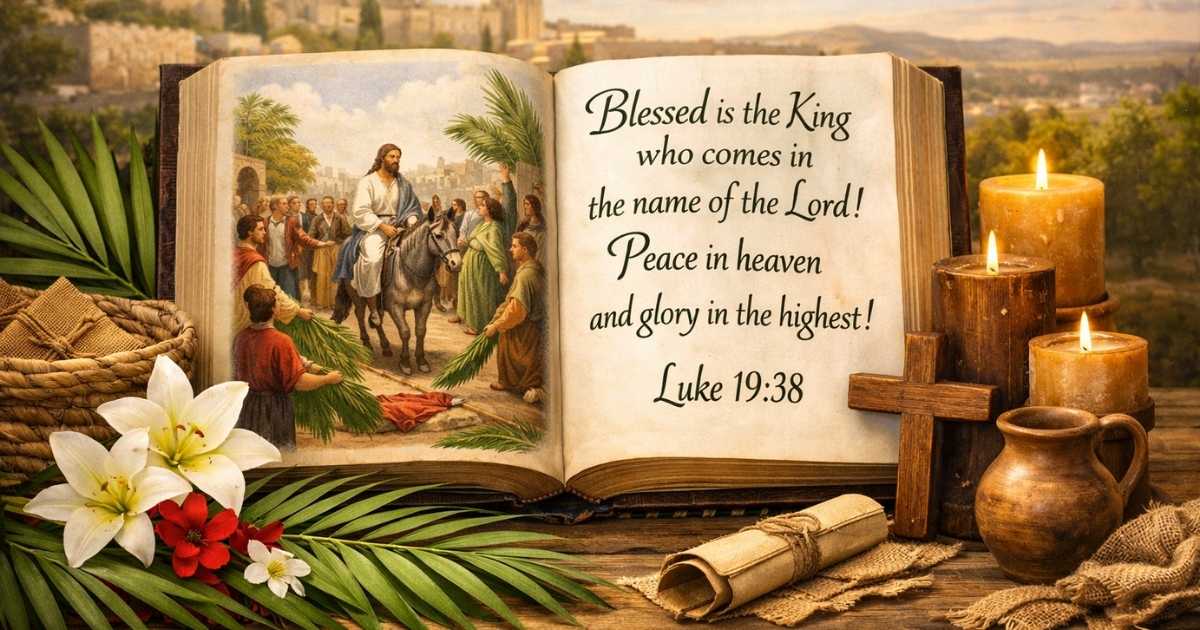

Palm Sunday Bible verses Luke records stand among the most powerful passages in all of Scripture. They capture the moment when Jesus rode into Jerusalem, fulfilling ancient prophecy and revealing His true identity as King.
Luke’s account in Luke 19:28–40 is rich with detail, emotion, and prophetic meaning. It invites believers to slow down, look closely, and discover truths that still speak today.
Whether you are a new believer or someone who has walked with Christ for years, this passage has something profound to offer. Let’s explore it together.
What is Palm Sunday?
Palm Sunday marks the day Jesus made His triumphal entry into Jerusalem, riding on a young donkey. The crowds welcomed Him with great joy, spreading their cloaks on the road and waving palm branches to honor Him as King.
This celebration takes place one week before Easter Sunday, officially opening what Christians call Holy Week. It is one of the most significant moments in the entire gospel story.
The day gets its name from the palm branches the crowds carried. In the ancient world, palm branches symbolized victory, honor, and royal welcome. Laying them before Jesus was a bold declaration of His kingship.
Yet Jesus entered humbly, not on a warhorse as a military conqueror would. He came on a donkey, fulfilling the prophecy of Zechariah 9:9: “See, your king comes to you, gentle and riding on a donkey.”
This was not coincidence. It was divine purpose in motion.
Key Bible Verses About Palm Sunday in Luke
Luke’s Gospel preserves this sacred event with careful detail. Each verse in Luke 19:28–40 carries deep spiritual weight and deserves close attention.
Luke 19:28–30
“After Jesus had said this, he went on ahead, going up to Jerusalem. As he approached Bethphage and Bethany at the hill called the Mount of Olives, he sent two of his disciples, saying to them, ‘Go to the village ahead of you, and as you enter it, you will find a colt tied there, which no one has ever ridden. Untie it and bring it here.'”
These verses reveal something remarkable: Jesus knew exactly what He would find before He arrived. His instructions were specific and certain, reflecting His divine knowledge of all things.
The Mount of Olives setting is deeply prophetic. Jewish tradition connected this location with the coming of the Messiah, making Jesus’ choice of route intentional and meaningful.
The detail about the colt being “one no one has ever ridden” also matters. Animals used for holy purposes in Israel had to be unbroken and unused, set apart entirely for God’s service (Numbers 19:2).
Luke 19:35–36
“They brought it to Jesus, threw their cloaks on the colt, and put Jesus on it. As he went along, people spread their cloaks on the road.”
The disciples’ response was immediate and wholehearted. Without hesitation, they placed their own garments beneath Jesus, a gesture of complete reverence and submission to their King.
Spreading cloaks on the road was a deeply intentional act. In ancient Middle Eastern culture, this was how people honored royalty, as seen when 2 Kings 9:13 describes the people laying garments before King Jehu.
What is beautiful here is that no one organized this response. It arose naturally from hearts that recognized the weight of the moment. True honor flows from genuine belief.
Luke 19:37–38
“When he came near the place where the road goes down the Mount of Olives, the whole crowd of disciples began joyfully to praise God in loud voices for all the miracles they had seen: ‘Blessed is the king who comes in the name of the Lord!’ ‘Peace in heaven and glory in the highest!'”
The crowd’s praise was not quiet or reserved. It was loud, joyful, and overflowing. These were people who had seen Jesus heal the sick, open blind eyes, and even raise the dead. Their worship came from real experience.
Their declaration, “Blessed is the king who comes in the name of the Lord,” comes directly from Psalm 118:26, a well-known messianic psalm. By quoting it, the crowd was making a bold theological statement about who Jesus was.
The closing line, “Peace in heaven and glory in the highest,” echoes the angels’ song at Jesus’ birth in Luke 2:14. Luke intentionally connects these two moments, framing the whole of Jesus’ life as one unified act of divine redemption.
Luke 19:39–40
“Some of the Pharisees in the crowd said to Jesus, ‘Teacher, rebuke your disciples!’ ‘I tell you,’ he replied, ‘if they keep quiet, the stones will cry out.'”
The Pharisees were deeply uncomfortable with what was happening. Public declarations of Jesus as Messiah threatened their religious authority and their carefully maintained relationship with Rome.
Their request to silence the disciples was not about reverence. It was about control. They wanted to manage the narrative and prevent a movement they could not contain.
Jesus’ response is one of the most striking statements in all of Scripture. When He said “the stones will cry out,” He declared that His identity as King and Messiah is not something human opposition can erase (Habakkuk 2:11).
Truth does not need permission to exist. It will make itself known.
Learn more:Luke Name Meaning Biblical: Origins, Significance & Stories
Lessons from Luke’s Account of Palm Sunday
Luke’s Palm Sunday narrative is more than a historical record. It is a treasury of spiritual lessons that every believer can carry into daily life.
1. Humility in Leadership
Jesus deliberately chose a donkey over a warhorse. That choice was a statement about the nature of His kingdom one built on servanthood, not strength; on sacrifice, not status.
Philippians 2:5–7 calls believers to share this same mindset: “Have the same mindset as Christ Jesus, who, being in very nature God, did not consider equality with God something to be used to his own advantage.”
True Christian leadership looks like Jesus on that donkey lowly, gentle, and entirely focused on others. It is a radical inversion of how the world defines greatness.
2. God’s Sovereignty
Every detail of Palm Sunday unfolded exactly as God had planned centuries earlier. The donkey, the road, the crowd, the praise nothing was accidental. Everything was ordained.
Isaiah 46:10 reminds us that God declares “the end from the beginning.” Palm Sunday is one of history’s clearest demonstrations that God’s plans cannot be thwarted by time, opposition, or circumstance.
This truth is deeply comforting. If God orchestrated every detail of Jesus’ entry into Jerusalem, He is equally present and purposeful in the details of your life.
3. True Worship
The crowd’s praise on that first Palm Sunday was spontaneous, Scripture-rooted, and full of joy. It was not performed for an audience. It flowed from hearts that had encountered the living God.
John 4:24 tells us that God seeks worshippers who worship “in spirit and in truth.” The Palm Sunday crowd embodied both dimensions emotional authenticity and theological accuracy.
Authentic worship today should carry the same quality. It is not about volume or style but about the genuine overflow of a heart that has seen what Jesus has done.
4. Boldness in Faith
The disciples praised Jesus publicly, knowing the Pharisees were watching and disapproving. They did not shrink back. Their faith expressed itself openly, regardless of the social cost.
Romans 1:16 captures this spirit well: “For I am not ashamed of the gospel, because it is the power of God that brings salvation to everyone who believes.”
Jesus’ response to the Pharisees also models bold, confident truth-telling. He did not apologize for the praise or soften His answer. He spoke with complete assurance about who He was.
Believers are called to that same unashamed boldness today.
How to Apply These Verses Today?

The Palm Sunday Bible verses Luke records are not simply history to admire they are truth to live. Here is how to bring these passages into your everyday walk with Christ:
- Study the fulfilled prophecies. Compare Zechariah 9:9, Psalm 118:26, and Luke 19:28–40 side by side. Watching prophecy become reality builds deep, lasting faith in God’s Word.
- Choose humility daily. In your home, your workplace, and your church, practice the servant leadership Jesus modeled. Ask yourself each morning: How can I serve rather than be served?
- Worship with your whole heart. Do not let your praise become routine. Let it be driven by fresh gratitude for what Jesus has done in your life, just as the crowd’s praise was driven by real miracles they had witnessed.
- Speak about Jesus openly. Share your faith with the confidence that the Holy Spirit works through bold witness. Do not wait for a perfect moment the stones are ready to cry out if you stay silent.
- Trust God’s timing completely. When life feels uncertain or out of control, return to the truth that God orchestrated every detail of Palm Sunday. He is just as sovereign over your story today.
- Honor Jesus as King in every area. Palm Sunday is a call to crown Christ as Lord over your finances, relationships, decisions, and habits not just on Sundays, but every single day.
FAQ’S
What are the Palm Sunday Bible verses in Luke?
Luke 19:28–40 contains the key Palm Sunday verses. They describe Jesus riding into Jerusalem on a donkey, fulfilling ancient prophecy about the coming Messiah.
Why did Luke write about Palm Sunday differently than other Gospel writers?
Luke emphasizes the crowd’s joyful praise and the Pharisees’ opposition, giving readers a detailed picture of both worship and resistance surrounding Jesus’ triumphal entry.
What does Luke 19:40 mean when Jesus says the stones will cry out?
Jesus declared that His identity as King cannot be silenced. Even creation itself would proclaim His lordship if every human voice were completely hushed.
What prophecy did Jesus fulfill on Palm Sunday according to Luke?
Jesus fulfilled Zechariah 9:9 by riding a young donkey into Jerusalem. This prophecy, written centuries earlier, pointed directly to the Messiah’s humble, peaceful arrival.
What lesson can believers learn from Palm Sunday Bible verses in Luke?
Believers learn to worship boldly, trust God’s sovereignty, embrace humble leadership, and proclaim Jesus as King fearlessly, just as the Palm Sunday crowd did.
Final Words
Palm Sunday Bible verses in Luke reveal a King unlike any the world had ever seen humble, purposeful, and perfectly fulfilling every promise God made. His entry into Jerusalem changed everything forever.
As you reflect on these passages, let them stir fresh worship, deeper trust, and bolder faith within you. The same Jesus who rode into Jerusalem is alive, reigning, and worthy of your highest praise today.