
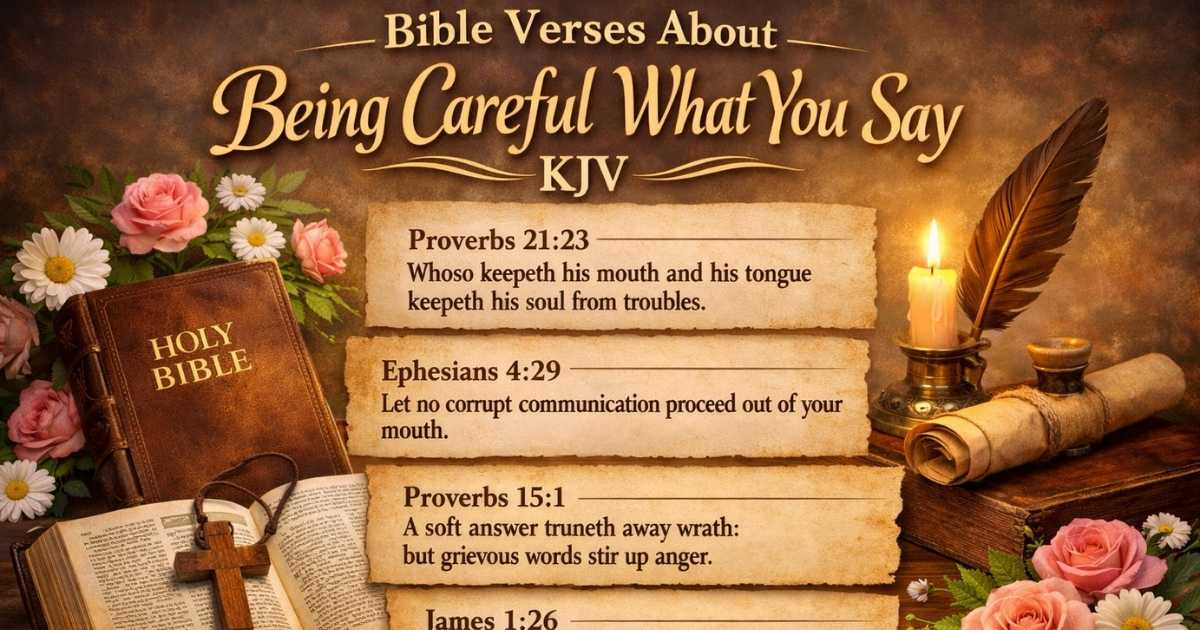

If you have ever searched for bible verses about being careful what you say KJV, you will quickly discover that the Bible places enormous value on wisdom, integrity, and careful living. The life of Mordecai is a powerful example of a man who lived with great discernment choosing his words, his actions, and his allegiances carefully before God and man. His story, found in the Book of Esther, teaches us that faithful, thoughtful living always leads to God’s reward.
bible verses about being careful what you say kjv
Mordecai was a Jewish man living in Persia during the reign of King Ahasuerus. He belonged to the tribe of Benjamin, and his forefather Kish had been carried into captivity from Jerusalem during the reign of King Nebuchadnezzar (Esther 2:5–6).
Though he lived as a foreigner in a strange land, Mordecai did not compromise his faith or his identity. He worked humbly as a gatekeeper at the king’s palace, faithfully serving without seeking recognition or personal glory.
His life reminds us of the wisdom found in Proverbs “A man’s heart deviseth his way: but the LORD directeth his steps” (Proverbs 16:9). Mordecai trusted God to direct his path even in exile.
Raised Up Esther and Led Her To Become The Queen
When Esther lost her parents at a young age, Mordecai took her in and raised her as his own daughter (Esther 2:7). This act of compassion and love reflects the heart of a man deeply rooted in godly character.
When the king began searching for a new queen to replace Vashti, Mordecai wisely guided Esther through the process. He carefully instructed her not to reveal her Jewish identity before the king (Esther 2:10).
This was a moment where being careful about what you say became a matter of life and death. Just as the KJV reminds us in Proverbs 21:23 “Whoso keepeth his mouth and his tongue keepeth his soul from troubles.” Mordecai understood this truth deeply and passed it on to Esther.
In time, Esther found favor before the king and was crowned queen. Mordecai’s patient guidance and God’s sovereign hand worked beautifully together.
Mordecai Saved King Ahasuerus by Revealing The Plot
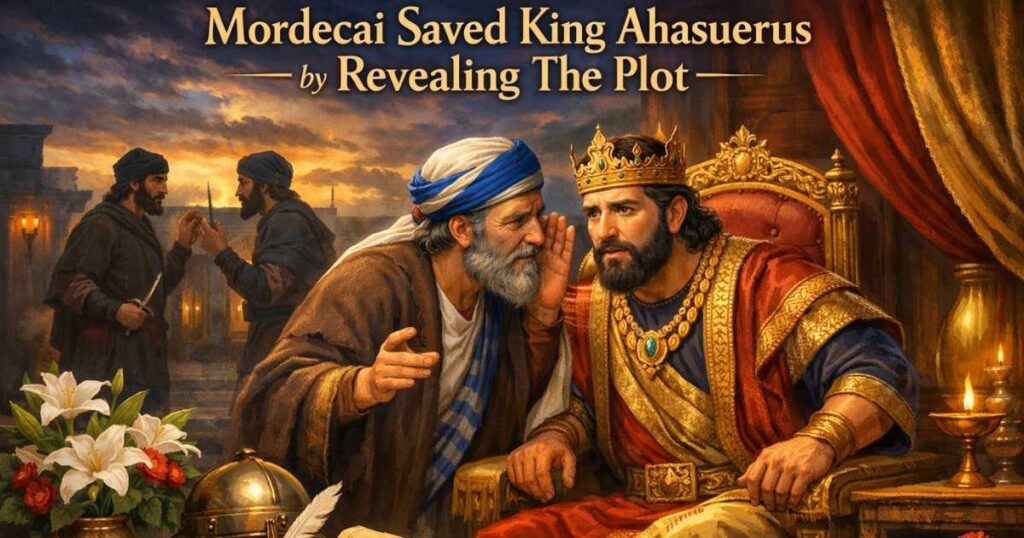
While positioned at the king’s gate, Mordecai overheard a deadly conspiracy. Two of the king’s eunuchs, Bigthan and Teresh, were secretly planning to assassinate King Ahasuerus.
Rather than staying silent or minding his own affairs, Mordecai acted with courage and loyalty. He brought the information to Esther, who reported it to the king in Mordecai’s name (Esther 2:21–22).
The plot was investigated, proven true, and both conspirators were hanged. The event was recorded in the official royal chronicles (Esther 2:23). Though Mordecai received no immediate reward, God was watching and keeping record.
This teaches us a beautiful truth faithfulness always gets noticed, even when men forget. “For God is not unrighteous to forget your work and labour of love” (Hebrews 6:10).
Mordecai Avoided Paying Homage To Haman
When Haman was promoted to the highest position in the kingdom, the king commanded that all servants at the gate must bow and pay him homage. Every servant obeyed except Mordecai (Esther 3:2).
Mordecai refused to bow because he was a Jew. From his childhood, he had been taught that reverence and worship belonged to God alone. He would not compromise that conviction regardless of the consequences.
The KJV reminds us in Acts 5:29 “We ought to obey God rather than men.” Mordecai lived this scripture with great personal courage.
When Haman discovered Mordecai’s refusal, he was filled with fury. Rather than dealing with Mordecai alone, Haman devised a wicked plan to destroy every Jew in all of Persia (Esther 3:6).
He also cast lots called Pur to determine the best time for his wicked scheme (Esther 3:7). His hatred was matched only by his pride, and both would eventually become his destruction.
Mordecai Urged Esther To Stand Before The King To Save His People
Learn more:Bible Verses About Healing A Broken Heart KJV
When the king’s deadly decree against the Jews was announced, Mordecai tore his clothes, put on sackcloth, and mourned openly in the city (Esther 4:1). He knew his refusal to bow had set these terrible events in motion, and the weight of that reality was heavy.
Esther sent clothes to comfort him, but he refused them. He needed Esther to understand the urgency and gravity of the moment (Esther 4:4).
Through a servant named Hathach, Mordecai communicated everything to Esther including a copy of Haman’s decree and urged her to approach the king on behalf of her people (Esther 4:8).
Esther hesitated, reminding him that approaching the king without being called meant death, unless the king extended his golden scepter. Mordecai’s reply is one of the most powerful statements in all of Scripture:
“For if thou altogether holdest thy peace at this time, then shall there enlargement and deliverance arise to the Jews from another place; but thou and thy father’s house shall be destroyed: and who knoweth whether thou art come to the kingdom for such a time as this?” (Esther 4:14).
Esther was moved. She called for a three-day fast among all the Jews, and then she resolved to stand before the king even at the risk of her own life (Esther 4:16).
Gallows Made For Mordecai
While Esther was preparing herself in prayer and fasting, Haman’s hatred for Mordecai continued to grow. After attending Esther’s first banquet with the king, Haman returned home and boasted about his wealth, his position, and his honor (Esther 5:11).
Yet the mere sight of Mordecai sitting unmoved at the king’s gate was enough to ruin his joy entirely (Esther 5:13).
At the advice of his wife Zeresh and his friends, Haman ordered the construction of a gallows seventy-five feet high specifically built to hang Mordecai the very next morning (Esther 5:14).
Haman’s pride had completely consumed him. He could not rest until the man who would not bow to him was destroyed. But as the KJV tells us “Pride goeth before destruction, and an haughty spirit before a fall” (Proverbs 16:18). Haman was unknowingly walking toward his own end.
King Ahasuerus Honored Mordecai For His Great Work
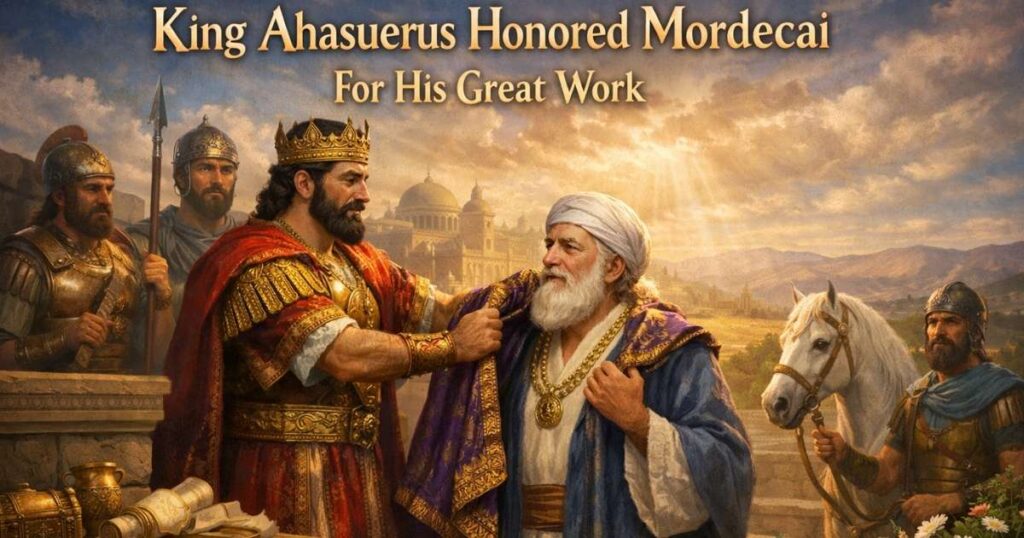
That very same night, King Ahasuerus could not sleep. He asked his servants to bring the royal chronicles and read them to him (Esther 6:1). As they read, the account of Mordecai uncovering the assassination plot was brought to his attention.
The king asked what honor had been given to Mordecai for this great deed. The servants replied nothing had been done (Esther 6:3).
At that very moment, Haman had entered the outer court, intending to request the king’s permission to hang Mordecai on the gallows he had just built. Before Haman could say a word, the king asked him “What shall be done unto the man whom the king delighteth to honour?” (Esther 6:6).
Haman, assuming the king meant him, described an elaborate royal honor. The king then commanded Haman to do exactly that for Mordecai (Esther 6:10).
Haman was humiliated. He had come to seek Mordecai’s death and instead was forced to publicly honor him. God had perfectly reversed the plans of the enemy.
Mordecai Was Exalted By The King Ahasuerus
At Esther’s second banquet, she finally revealed her petition to the king. She exposed Haman’s wicked plot to destroy her people the Jews (Esther 7:3–4). The king was furious when he understood the depth of Haman’s wickedness.
Haman was immediately condemned. He was hanged on the very gallows he had built for Mordecai (Esther 7:10). What a powerful picture of divine justice.
After Haman’s death, Esther told the king how Mordecai had raised her after the loss of her parents. The king responded by giving Mordecai the signet ring that had been taken from Haman (Esther 8:2).
Esther further appointed Mordecai over the house of Haman (Esther 8:2). The man who had been sitting humbly at the king’s gate was now elevated to a position of great authority and honor.
This is the faithfulness of God. “Humble yourselves therefore under the mighty hand of God, that he may exalt you in due time” (1 Peter 5:6).
Mordecai Became Famous Throughout The Provinces Of Persia
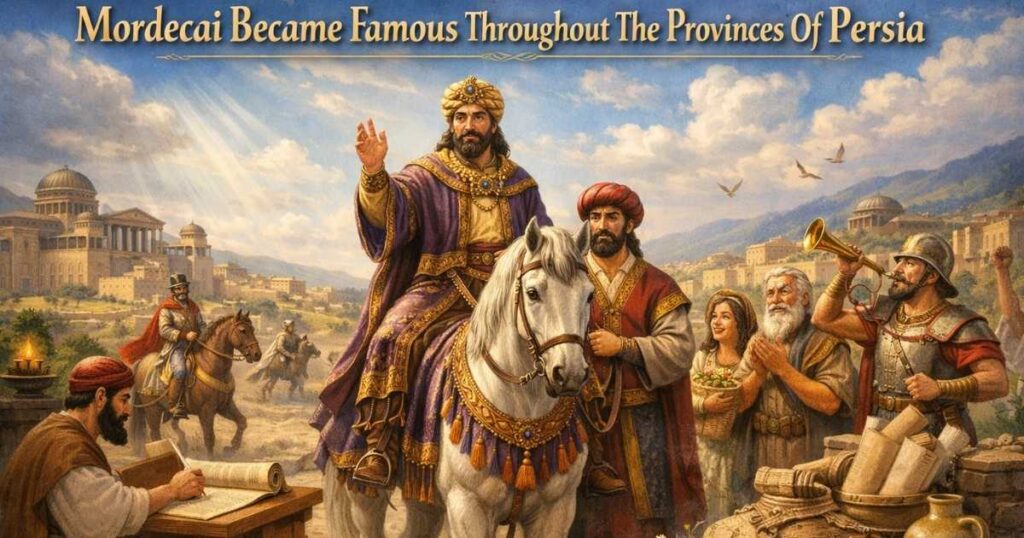
A new royal decree was issued, giving the Jewish people the right to defend themselves against any who sought to destroy them (Esther 8:11). When this decree spread throughout all the provinces, the Jews rejoiced greatly.
On the thirteenth day of the month of Adar, the enemies of the Jews rose against them but were thoroughly defeated. The fear of Mordecai had fallen upon all the people (Esther 9:3–4).
Mordecai’s name became great and his influence spread across every province of Persia. He was second only to the king in power and authority. He was beloved among the multitude of his people, working good for his people and speaking peace to all (Esther 10:3).
His rise from a humble gatekeeper to the second most powerful man in Persia was not by chance. It was the sovereign hand of God rewarding faithfulness, integrity, and careful, godly living.
Mordecai Wrote The Jews To Celebrate The Feast Of Purim Every Year
After the great deliverance of the Jewish people, Mordecai recorded all these events and sent letters to Jews in all the provinces of King Ahasuerus (Esther 9:20).
He commanded them to observe the fourteenth and fifteenth days of the month of Adar each year as days of feasting, joy, and celebration days of sending gifts to one another and giving to the poor (Esther 9:22).
This celebration became known as the Feast of Purim, named after the Pur the lot that Haman had cast to destroy the Jews (Esther 9:26). What Haman had used to plot destruction, God transformed into a season of celebration and remembrance.
Esther also confirmed the decree of Purim with her own authority (Esther 9:29). The feast became a permanent part of Jewish life a yearly reminder that God is faithful to deliver His people from the hands of their enemies.
“The LORD is my rock, and my fortress, and my deliverer” (Psalm 18:2). The story of Mordecai and Purim echoes this truth across every generation.
Final Words
The life of Mordecai teaches every believer to live with godly wisdom, careful speech, and unshakeable faith. His story proves that faithful obedience to God always leads to divine promotion and lasting honor before men and nations.
Just as bible verses about being careful what you say KJV remind us, our words and choices carry great weight before God. Let Mordecai’s life inspire you to trust God deeply, speak wisely, and never bow to the pressures of this world.